


International Stocks Remain Near the Top, but Emerging Markets Show Signs of Weakness
International stocks were recently overtaken by U.S. stocks in our investment rankings. Our Dynamic Asset Level Investing (DALI) system measures the relative strength of different types of investments to help identify which areas of the market are performing best. Currently, International Equities have a score of 186, compared with 188 for Domestic Equities—a difference of just two points.
This close competition is nothing new. Since March, neither group has established a meaningful lead over the other. Until recently, international stocks have held the top position for most of that time, but U.S. stocks have remained competitive.
The takeaway is that both U.S. and international stocks continue to demonstrate relative strength, with neither showing a decisive advantage.
Not All International Markets Are Performing Equally
While international stocks remain strong overall, a closer look reveals important differences between developed and emerging markets.
Developed markets generally include established economies such as Japan, Germany, and the United Kingdom. Emerging markets include developing economies such as China, India, and Brazil, which can offer greater growth potential but often experience larger price swings.
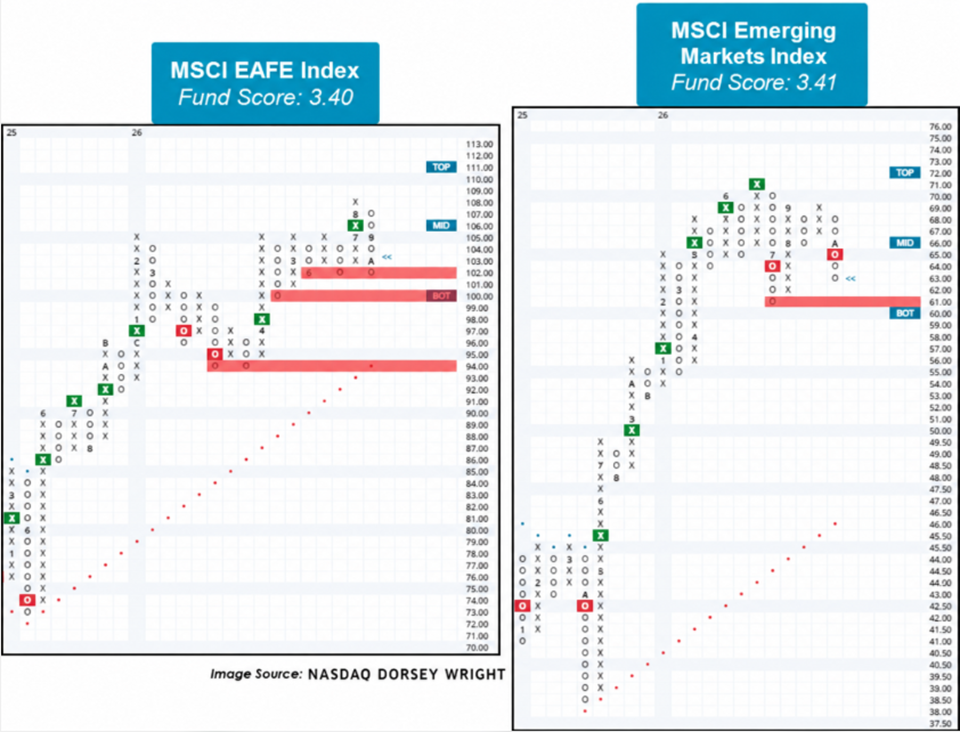
Two market indices help illustrate these differences:
- MSCI EAFE Index: Tracks stocks in developed international markets outside the United States and Canada.
- MSCI Emerging Markets Index: Tracks stocks in emerging economies.
Although both indices currently have nearly identical technical strength scores, their recent performance trends tell different storiesDeveloped international markets, represented by the MSCI EAFE index, have held up relatively well. The index remains in a longer-term upward trend, despite pulling back from its recent highs. Its current price pattern suggests some weakness, but the broader positive trend remains intact.
Emerging markets, represented by the MSCI Emerging Markets index, have experienced a more significant decline. While their longer-term trend remains positive, recent selling pressure has been noticeably stronger.
This distinction is important because international markets do not always move together. Some regions may continue performing well even as others experience temporary setbacks or more prolonged declines.
Source: Nasdaq Dorsey Wright
Are Emerging Markets Approaching a Turning Point?
Emerging market stocks have experienced considerable selling pressure in recent weeks, raising an important question: Is this simply a temporary pullback, or could it signal the beginning of a more significant decline? At this point, the answer is not clear.
One indicator we monitor measures how far an investment has moved above or below its normal trading range. Recently, emerging market stocks reached their most oversold weekly reading since the market volatility associated with tariff announcements in April 2025.
An oversold reading generally means an investment has experienced unusually strong selling pressure over a relatively short period.
While this can indicate continued weakness, it can also suggest that selling has become excessive and a potential rebound may be approaching.
However, an oversold market does not automatically mean prices have reached their lowest point. Markets can remain under pressure longer than expected.
What Are the Technical Indicators Telling Us?
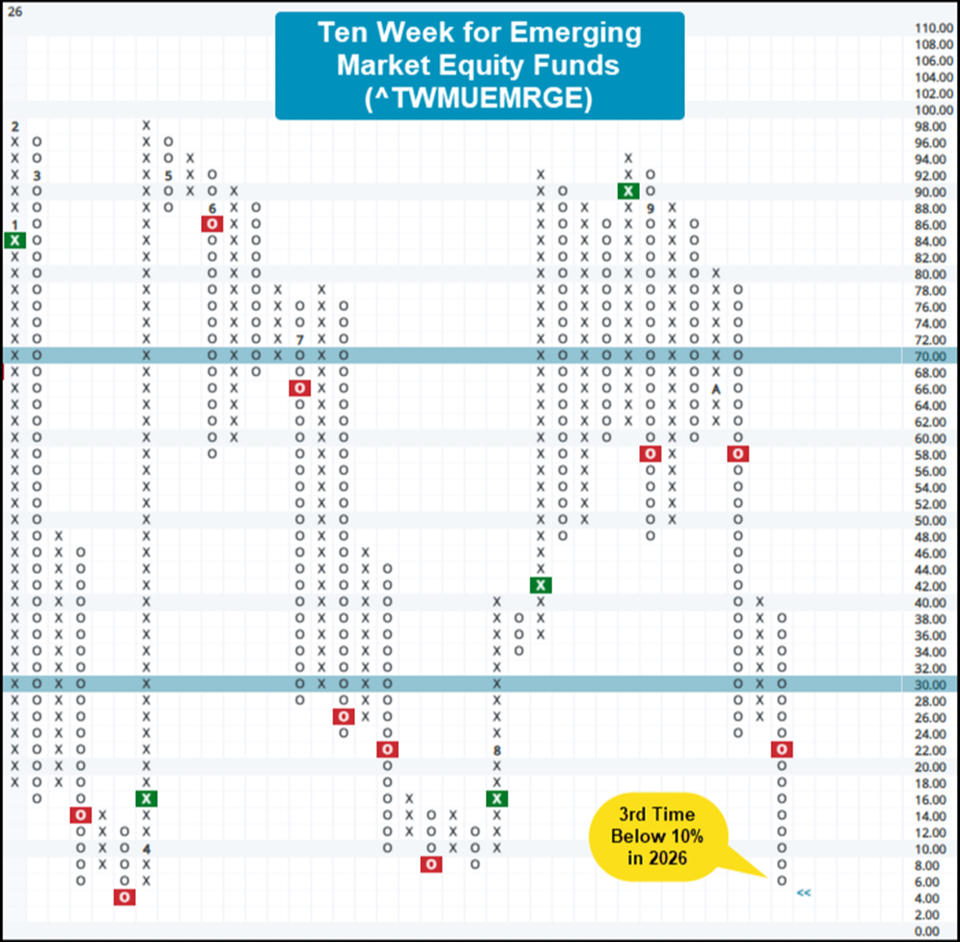
Another useful measure examines how many emerging market funds are trading above their average price over the past 10 weeks, or approximately 50 trading days.
This indicator recently fell to just 6%, meaning approximately 94% of the emerging market funds being measured were trading below their 10-week average prices.
That is a significant indication of widespread weakness.
Interestingly, this is the third time this year that the indicator has fallen below 10%. Although such readings may seem alarming, sharp declines and recoveries are not unusual in emerging markets.
Historically, extremely low readings can sometimes precede a rebound as investors begin returning to stocks that have experienced substantial selling pressure.
For now, we are watching for signs that the indicator begins moving higher. An improvement would suggest that buying interest is returning and could provide an early indication that emerging market stocks are beginning to stabilize.
On the other hand, continued weakness could signal that the recent decline has further to go.
What Does This Mean for Investors?
International stocks remain an important area of strength, but recent developments remind us why it is essential to look beyond broad market averages.
Developed international markets have demonstrated greater stability, while emerging markets have experienced more pronounced weakness.
Neither trend necessarily determines what will happen next. However, these differences reinforce the importance of monitoring market conditions and maintaining flexibility in investment allocations
At Main Street Wealth Advisors, we believe that a disciplined investment approach involves identifying areas of relative strength while remaining alert to changing market conditions.
The bottom line: International stocks continue to compete closely with U.S. stocks for market leadership. Although emerging markets have weakened considerably, their recent decline may eventually create opportunities if buying interest returnsRather than attempting to predict the next market move, we will continue monitoring these trends and adjusting our investment outlook as conditions evolve.
Our focus remains on helping clients participate in long-term investment opportunities while managing risk through changing market environments.
Source: Nasdaq Dorsey Wright
Below is the most recent D.A.L.I. (Dynamic Asset Level Investing) Indicator showing Domestic Equities and International Equities battling for the top spot, while Cash and Fixed Income remain far behind.

Source: Nasdaq Dorsey Wright
The current reading for the PR4050 Cash Trigger is: U.S. Equity Core = 99.30% & Money Market = 18.31%. For the PR4050 indicator to trigger and alert us when we should consider moving to cash, U.S. Equity Core must be 40% or below and Money Market must be 50% or above.

Source: Nasdaq Dorsey Wright
P.S. If you believe this information would be of benefit to anyone you know, please share this communication with them. Also, if you, or someone you know, would like to be added to the weekly market update, please click here to provide us with the e-mail address.
Main Street Wealth Advisors
33801 1st Way South, Suite 271
Federal Way, WA 98003
Office: (253) 944-1047
Fax: (253) 944-1075
ART-1196899
Securities and advisory services offered through LPL Financial, a Registered Investment Advisor, Member FINRA/SIPC.
These views are those of the author, not of the broker-dealer or its affiliates. This material contains an assessment of the market and economic environment at a specific point in time and is not intended to be a forecast of future events, or a guarantee of future results. All investments involve risk, including loss of principal. Forward-looking statements are subject to certain risks and uncertainties. Actual results, performance, or achievements may differ materially from those expressed or implied. Information is based on data gathered from what we believe are reliable sources. All indices are unmanaged and may not be invested into directly.
Technical analysis is based on the study of historical price movements and past trend patterns. There is no assurance that these movements or trends can or will be duplicated in the future. Nasdaq Dorsey Wright developed the indicators described above. They have been prepared without regard to any particular investor's investment objectives, financial situation, and needs. Accordingly, investors should not act on any recommendation (express or implied) or information in this report without obtaining specific advice from their financial advisors and should not rely on information herein as the primary basis for their investment decisions.
Nasdaq Dorsey Wright’s “DALI" employs relative strength-based analysis to rank macro asset classes based on developing leadership trends within the global capital markets. The objective guidance within DALI provides the tools necessary to properly allocate portfolios across all major asset classes in an effort to emphasize strength wherever it exists. Domestic Equities, International Equities, Commodities, Currencies, Fixed Income and Cash are evaluated daily to identify dynamic developments across investment genres, as well as within them. This tool provides the tactical precision that allows investors to adapt as the market leadership changes.
International investing involves special risks such as currency fluctuation and political instability and may not be suitable for all investors. These risks are often heightened for investments in emerging markets.
This material is for general information only and is not intended to provide specific advice or recommendations for any individual. There is no assurance that the views or strategies discussed are suitable for all investors or will yield positive outcomes. Investing involves risks including possible loss of principal. Any economic forecasts set forth may not develop as predicted and are subject to change.
The NASDAQ Composite Index measures all NASDAQ domestic and non-U.S. based common stocks listed on The NASDAQ Stock Market. The market value, the last sale price multiplied by total shares outstanding, is calculated throughout the trading day, and is related to the total value of the Index.
The S&P 500® Index: A free-float capitalization-weighted index published since 1957 of the prices of 500 large-cap common stocks actively traded in the United States. The stocks included in the S&P 500® are those of large publicly held companies that trade on either of the two largest American stock market exchanges: the New York Stock Exchange and the NASDAQ.
MSCI World Index: A broad global equity index that represents large and mid-cap equity performance across 23 developed markets countries.
Bonds are subject to market and interest rate risk if sold prior to maturity. Bond values will decline as interest rates rise and bonds are subject to availability and change in price.