


Elections Come and Go. The Market Keeps Moving.
With the 2026 midterm elections now behind us, political headlines, election results, and speculation about the direction of Washington are dominating the news. For investors, it is natural to wonder what these developments might mean for the stock market, the economy, and their financial future.
At Main Street Wealth Advisors, we believe history offers an important perspective: While elections can influence market sentiment and create short-term volatility, long-term investment success has depended far more on economic fundamentals, corporate performance, and remaining disciplined than on which political party controls Washington.
A recent analysis from Russell Investments examines nearly a century of market performance through election cycles, changing political leadership, economic uncertainty, and geopolitical events. The findings offer several valuable reminders for investors.
1. Markets Have Historically Responded Favorably to Clarity Following Midterm Elections
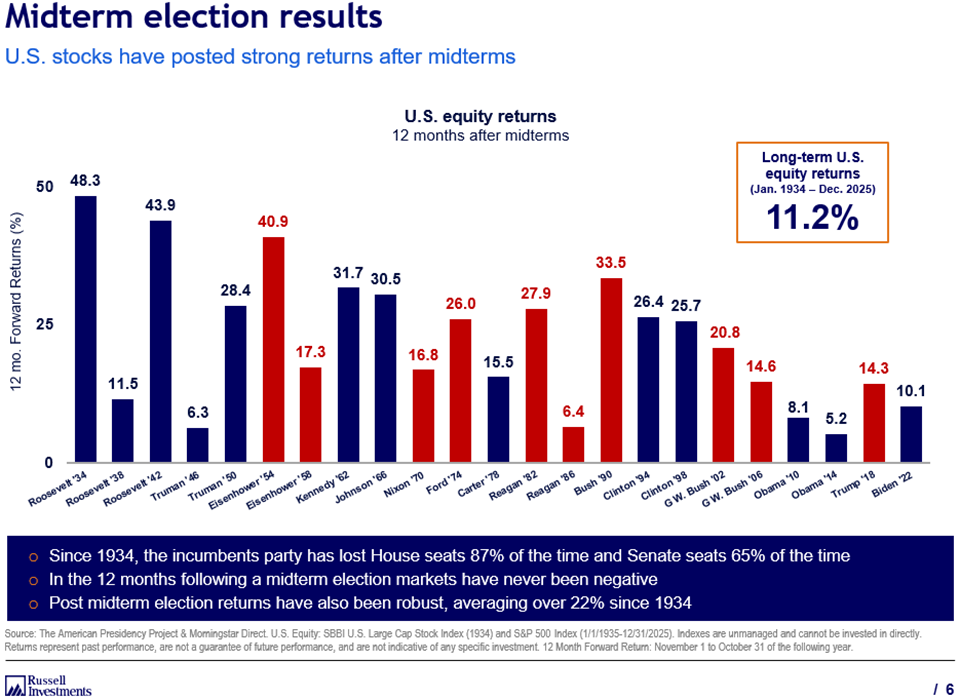
One of the more interesting historical patterns is how stocks have performed before and after midterm elections.
Since 1934, U.S. stocks have generally experienced more muted returns leading up to midterm elections, followed by stronger performance once election uncertainty begins to subside.
According to the Russell Investments research:
- The president's party has lost seats in the House of Representatives in approximately 87% of midterm elections.
- The president's party has lost Senate seats approximately 65% of the time.
- The S&P 500 and its historical large-cap predecessors have averaged returns exceeding 22% during the 12 months following midterm elections.
- In the historical periods examined through 2025, the market did not experience a negative 12-month return following a midterm election.
These statistics are encouraging, but they should not be interpreted as a prediction for the coming year. Historical patterns can change, and past performance never guarantees future results.
Source: Russell Investments
The broader lesson is that markets often respond positively when political uncertainty gives way to greater clarity about future policy.
2. Neither Political Party Has a Monopoly on Strong Market Performance
Political preferences can strongly influence how Americans feel about the economy. However, those feelings do not always align with what is actually happening in the stock market.
Russell Investments examined stock market performance under various combinations of Republican and Democratic control of the presidency, Senate, and House of Representatives.
The findings indicate that no political party has consistently delivered superior market returns since World War II.
Markets have experienced substantial growth under Republican presidents, Democratic presidents, divided governments, and periods when one party controlled both Congress and the White House.
Why?
Because stock prices ultimately reflect factors extending well beyond politics, including corporate earnings, innovation, consumer spending, interest rates, inflation, and economic growth.
Government policies certainly matter, particularly those involving taxation, regulation, trade, and federal spending. However, investors are generally better served by evaluating the economic effects of policies rather than making investment decisions based solely on political personalities or party affiliation.
3. Investor Sentiment Can Change Overnight. Economic Fundamentals Usually Do Not.
One of the most revealing findings involves the relationship between political affiliation and consumer sentiment.
Research from the University of Michigan demonstrates that Americans' perceptions of the economy frequently shift when the political party occupying the White House changes.
Supporters of the incoming party often become more optimistic, while supporters of the opposing party frequently become more pessimistic.
Yet the stock market has historically demonstrated considerable resilience through these shifts in sentiment.
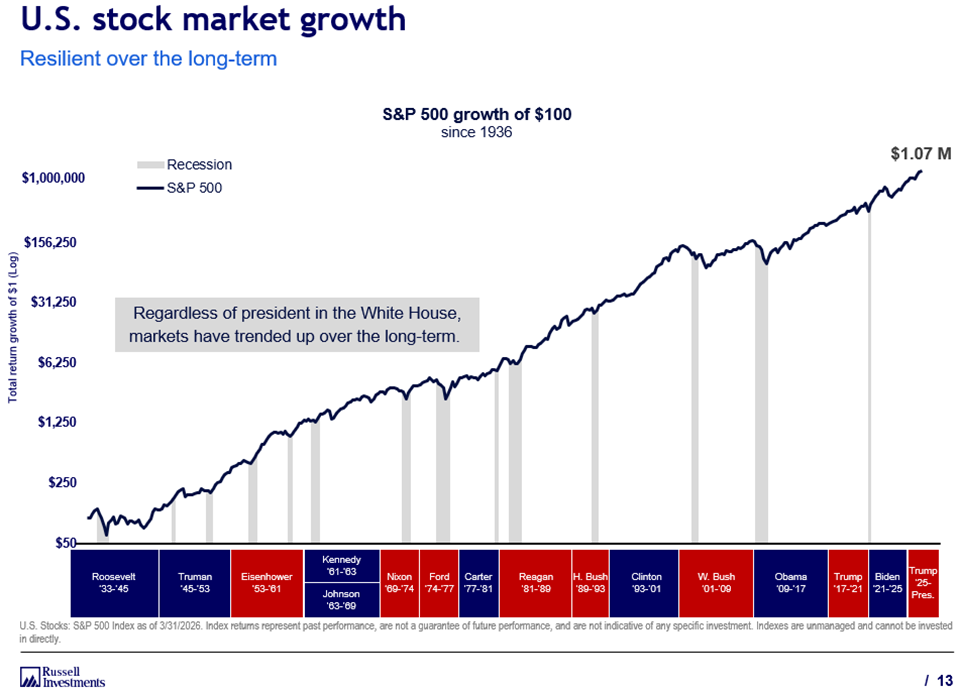
Russell Investments reports that the S&P 500 generated a cumulative return of approximately 947.5% beginning in 2009 through the period examined in its research.
During that time, the United States experienced multiple presidential administrations, changes in congressional leadership, economic disruptions, and significant geopolitical events.
The lesson is straightforward:
How investors feel about the economy and how their investments actually perform are two very different things.
Allowing political frustration or enthusiasm to dictate investment decisions can introduce unnecessary risk into an otherwise sound financial strategy.
4. Staying Invested Has Historically Been More Rewarding Than Trying to Time Elections
Election years frequently create the temptation to move investments into cash until the political environment feels more predictable.
While holding cash can be appropriate for short-term spending needs, emergency reserves, and certain financial objectives, moving long-term investments in and out of the market based on election outcomes can be costly.
Russell Investments examined average four-year investment returns beginning at different points in the presidential election cycle.
The findings showed that average forward returns were relatively similar across pre-election years, election years, post-election years, and midterm election years.
In other words, historically there has not been a consistently superior point in the election cycle to begin investing.
Meanwhile, investors who move into cash during periods of uncertainty face another challenge: determining when to reinvest.
Market recoveries can occur quickly, sometimes before the news or economic outlook begins to improve.
Missing even a relatively small number of strong market days can materially affect long-term investment results.
For investors with appropriate time horizons and diversified portfolios, maintaining a disciplined investment strategy has historically been more effective than attempting to anticipate political outcomes.
There is no guarantee that a diversified portfolio will enhance overall returns or outperform a non-diversified portfolio. Diversification does not protect against market risk.
5. Federal Debt and Geopolitical Uncertainty Are Important, but Not New
Concerns about federal debt, government spending, international conflicts, and economic stability are understandable.
These issues can influence interest rates, inflation, business investment, and financial markets.
However, they are not unique to today's political environment.
Russell Investments examined federal debt levels dating back to 1940 and found that, despite substantial changes in government borrowing and debt relative to the size of the economy, U.S. stocks generated average annual returns of approximately 11.4% over the period studied.
Similarly, the research reviewed major geopolitical disruptions dating back to 1939.
Although these events sometimes produced significant short-term market declines, U.S. stocks have repeatedly demonstrated an ability to recover and grow over longer periods.
This does not mean federal debt or geopolitical risks should be ignored. Both can have meaningful economic consequences, and individual market recoveries can take considerable time.
Rather, the historical evidence reminds us that uncertainty has always been part of investing.
Successful long-term investing does not require the absence of uncertainty. It requires a strategy designed to navigate it.
6. The Bigger Picture: America's Long-Term Economic Growth
Perhaps the most important takeaway from the Russell Investments research is the long-term growth of the U.S. stock market across generations of political leadership.
From Franklin Roosevelt through the current Trump administration, the United States has experienced wars, recessions, inflation, financial crises, political divisions, technological revolutions, and periods of extraordinary economic expansion. Despite these challenges, the long-term direction of the U.S. stock market has been upward.
Source: Russell Investments
That growth reflects the ability of American businesses to innovate, adapt, compete, and create value over time.
The benefits also extend beyond individual brokerage and retirement accounts. A growing economy and successful businesses can support employment, wages, pension assets, charitable endowments, and the broader tax base that helps fund public services.
While not everyone participates directly in the stock market, its long-term performance can have implications throughout the economy.
Of course, markets do not rise in a straight line, and there will always be periods of disappointing returns.
Nevertheless, history suggests that investors who maintain an appropriate long-term perspective are better positioned to participate in economic growth than those who continually react to political headlines.
Our Perspective at Main Street Wealth Advisors
The 2026 midterm elections may influence the direction of tax policy, government spending, regulation, and other economic priorities over the next two years.
We will continue evaluating those developments and their potential implications for the economy and financial markets.
However, we do not believe that election results alone should dictate major changes to a thoughtfully constructed investment portfolio.
Instead, our focus remains on the factors that matter most to each client's long-term financial success: maintaining appropriate diversification, managing risk, monitoring market conditions, and aligning investment decisions with individual financial objectives.
There will always be another election, another economic concern, and another headline suggesting that this time is different.
History reminds us that markets have navigated considerable uncertainty before.
The goal is not to predict every political outcome. It is to build and maintain a financial strategy capable of weathering a wide range of outcomes.
As always, we appreciate the trust you place in Main Street Wealth Advisors and remain committed to helping you navigate changing markets with continued trust
Below is the most recent D.A.L.I. (Dynamic Asset Level Investing) Indicator showing Domestic Equities extending its lead over International Equities, while Cash and Fixed Income remain far behind.

Source: Nasdaq Dorsey Wright
The current reading for the PR4050 Cash Trigger is: U.S. Equity Core = 97.89% & Money Market = 15.49%. For the PR4050 indicator to trigger and alert us when we should consider moving to cash, U.S. Equity Core must be 40% or below and Money Market must be 50% or above.

Source: Nasdaq Dorsey Wright
P.S. If you believe this information would be of benefit to anyone you know, please share this communication with them. Also, if you, or someone you know, would like to be added to the weekly market update, please click here to provide us with the e-mail address.
Main Street Wealth Advisors
33801 1st Way South, Suite 271
Federal Way, WA 98003
Office: (253) 944-1047
Fax: (253) 944-1075
ART-1204593
Securities and advisory services offered through LPL Financial, a Registered Investment Advisor, Member FINRA/SIPC.
These views are those of the author, not of the broker-dealer or its affiliates. This material contains an assessment of the market and economic environment at a specific point in time and is not intended to be a forecast of future events, or a guarantee of future results. All investments involve risk, including loss of principal. Forward-looking statements are subject to certain risks and uncertainties. Actual results, performance, or achievements may differ materially from those expressed or implied. Information is based on data gathered from what we believe are reliable sources. All indices are unmanaged and may not be invested into directly.
Technical analysis is based on the study of historical price movements and past trend patterns. There is no assurance that these movements or trends can or will be duplicated in the future. Nasdaq Dorsey Wright developed the indicators described above. They have been prepared without regard to any particular investor's investment objectives, financial situation, and needs. Accordingly, investors should not act on any recommendation (express or implied) or information in this report without obtaining specific advice from their financial advisors and should not rely on information herein as the primary basis for their investment decisions.
Nasdaq Dorsey Wright’s “DALI" employs relative strength-based analysis to rank macro asset classes based on developing leadership trends within the global capital markets. The objective guidance within DALI provides the tools necessary to properly allocate portfolios across all major asset classes in an effort to emphasize strength wherever it exists. Domestic Equities, International Equities, Commodities, Currencies, Fixed Income and Cash are evaluated daily to identify dynamic developments across investment genres, as well as within them. This tool provides the tactical precision that allows investors to adapt as the market leadership changes.
International investing involves special risks such as currency fluctuation and political instability and may not be suitable for all investors. These risks are often heightened for investments in emerging markets.
This material is for general information only and is not intended to provide specific advice or recommendations for any individual. There is no assurance that the views or strategies discussed are suitable for all investors or will yield positive outcomes. Investing involves risks including possible loss of principal. Any economic forecasts set forth may not develop as predicted and are subject to change.
The NASDAQ Composite Index measures all NASDAQ domestic and non-U.S. based common stocks listed on The NASDAQ Stock Market. The market value, the last sale price multiplied by total shares outstanding, is calculated throughout the trading day, and is related to the total value of the Index.
The S&P 500® Index: A free-float capitalization-weighted index published since 1957 of the prices of 500 large-cap common stocks actively traded in the United States. The stocks included in the S&P 500® are those of large publicly held companies that trade on either of the two largest American stock market exchanges: the New York Stock Exchange and the NASDAQ.
MSCI World Index: A broad global equity index that represents large and mid-cap equity performance across 23 developed markets countries.
Bonds are subject to market and interest rate risk if sold prior to maturity. Bond values will decline as interest rates rise and bonds are subject to availability and change in price.