


Despite recent market volatility and sharp pullbacks in several mega-cap technology stocks, the S&P 500 remains only about 3% below the all-time high it reached in June after rebounding nearly 20% from its March low.
Because the market recovered so quickly after its first-quarter decline, many investors may feel they missed the opportunity to "buy the dip." Now, with stocks once again near record highs and renewed geopolitical tensions in the Middle East creating uncertainty, it's understandable that some investors are hesitant to put new money to work.
In the short term, there are valid reasons for caution. From both a fundamental and technical perspective, the market may face headwinds that could limit further gains. However, history shows that there have been surprisingly few truly poor times to invest for those with a long-term perspective.
At Main Street Wealth Advisors, we do not believe in simply buying and holding the S&P 500 regardless of market conditions. As active portfolio managers, we continually evaluate market trends, rotating toward areas demonstrating relative strength while adjusting overall portfolio exposure as conditions change. Rather than waiting for the "perfect" time to invest—a moment that rarely exists—we believe it is more valuable to understand how markets have historically rewarded patient investors, even when they began investing during periods of uncertainty.
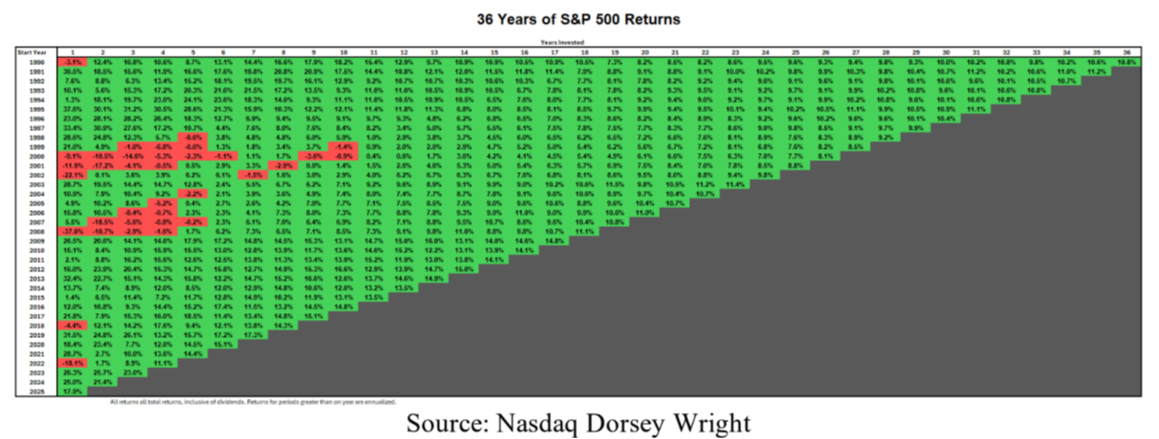
The chart below illustrates the annualized returns of the S&P 500 Total Return Index for every starting year from 1990 through 2025. For example, an investment made at the end of 1989 (the 1990 starting point) reflects 36 years of performance, while an investment beginning at the end of 1990 reflects 35 years, and so on.
One of the most important takeaways is that, regardless of when an investment was made, most starting points produced positive annualized returns within just a few years.
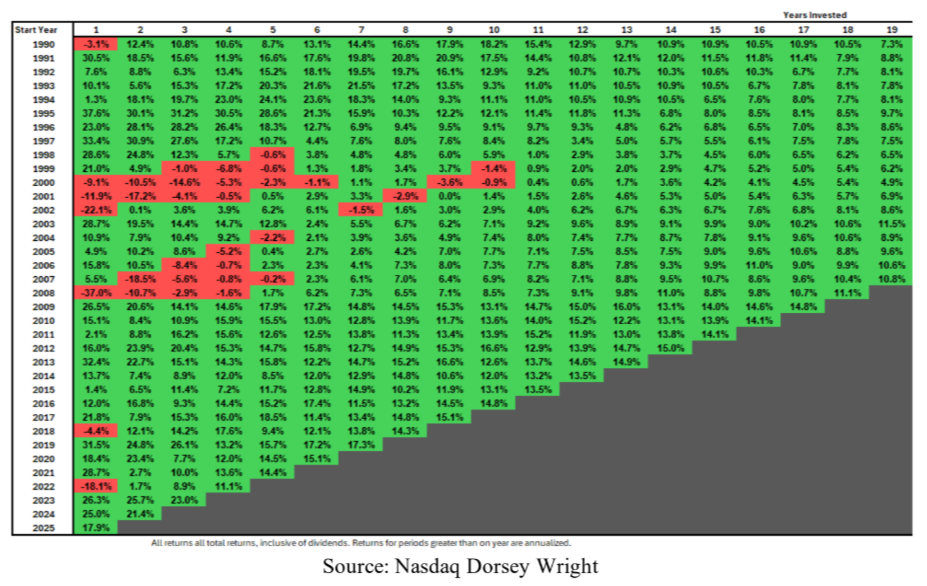
Of course, history has included periods that tested investors' patience. Those who invested around the peaks of the dot-com bubble (2000–2002) or just before the Global Financial Crisis (2008) experienced several years of negative returns before markets recovered.
Even so, the long-term results remain compelling. After 25 years, investors who entered the market during the technology bubble earned annualized returns of roughly 7.7%. While that trailed investors who entered just a few years earlier by approximately 2% per year—a meaningful difference over time—it still substantially outperformed remaining in cash over the same period.
Perhaps the most encouraging lesson is how few truly "bad" entry points history has produced. Investors who entered the market in 2007, immediately before the Global Financial Crisis, have still earned annualized returns approaching 11% over the past 19 years. Likewise, investors who began in 2022—just before another significant market decline—have already achieved annualized returns exceeding 11%.
It's also important to remember that these figures represent a simple buy-and-hold investment in the S&P 500. Investors who employed a disciplined, tactical investment approach—reducing exposure to weaker areas of the market and emphasizing stronger sectors—may have achieved even better long-term outcomes during challenging periods such as the dot-com collapse.
While no one can predict what the market will do over the next few months, history suggests that long- term success is less about finding the perfect entry point and more about maintaining a disciplined investment strategy through changing market environments.
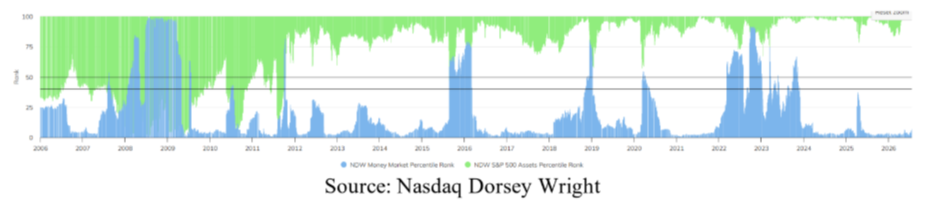
The current reading for the PR4050 is: U.S. Equity Core = 98.59% & Money Market = 7.04%. For the PR4050 indicator to trigger and alert us when we should consider moving to cash, U.S. Equity Core must be 40% or below and Money Market must be 50% or above.
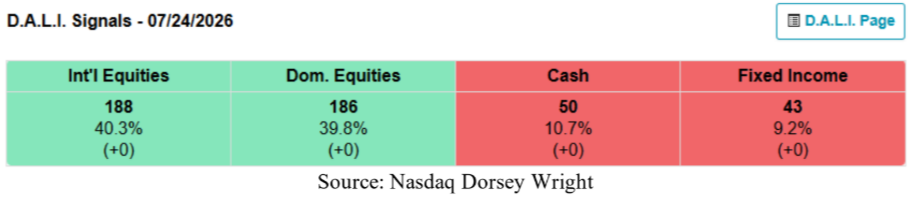
Below is the most recent D.A.L.I. (Dynamic Asset Level Investing) Indicator showing International Equities and Domestic Equities in the top two spots, while both maintain a commanding lead over Cash and Fixed Income.
P.S. If you believe this information would be of benefit to anyone you know, please share this communication with them. Also, if you, or someone you know, would like to be added to the weekly market update, please click here to provide us with the e-mail address.